History
Nestled by the tree-lined River Medway near Aylesford is the principal house of the Carmelite religious order that came to Kent in 1242. A compelling story of the Friars and the Carmelites of Aylesford who were forced from their priory in 1538 only to return 400 years later in 1949, is told in the artworks and buildings discovered on a short walk through the grounds. Here you’ll come across one of the finest intact medieval courtyards in England, 17th-century thatched barns and a hostelry for pilgrims dating to the late 1200s.
In its 750-year history, this venerable oasis has changed use many times. In the centuries after the Reformation, the monastic was converted into an opulent stately home. Merchant bankers, Royalists during the Civil War, Second World War servicemen and even the leader of a Scout group have all left their mark.
When the Carmelite family returned in the mid-20th century, they restored the tranquil gardens, built chapels and adorned them with distinguished ceramic artworks. Father Malachy Lynch who spearheaded the reconstruction, memorably described the Friars as a “prayer in stone”.
Photo caption (right) The arrival of the Carmelites to Aylesford in 1242 by Adam Kossowski
Photo caption (above centre) The first outdoor Shrine in the early 1950s.
The 13th Century
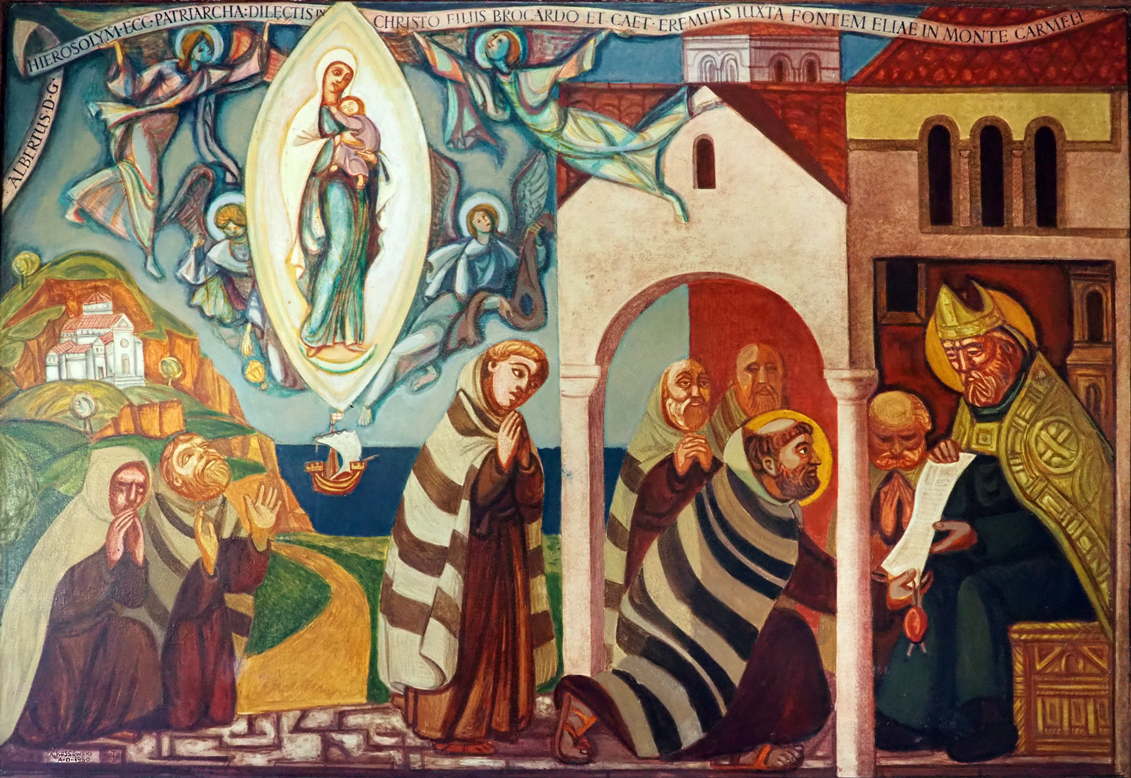
The Carmelites are a religious order with roots that go back to the Crusades. The first Carmelites were hermits who settled on Mt. Carmel, overlooking the port of Heifer in what is now modern-day Israel. The first hermits lived a life of prayer with a particular devotion to Mary that they honoured with the title “Our Lady of Mount Carmel”. Mount Carmel is also associated with the prophet Elijah, who inspired the hermits with the love of God. They adopted his motto as their own “With zeal I have been zealous for the Lord God of Hosts”. The hermits’ blend of solitude and community was guided by a ‘Way of Life’ given by St. Albert of Jerusalem, the Latin Patriarch bishop of Jerusalem. The Rule of St. Albert continues to guide the Carmelites today.
When it became unsafe for the hermits to remain in Palestine, they travelled to Europe with returning crusaders. A small group of hermits arrived at Aylesford in 1242 where Baron Richard de Grey gave them his manor. This was one of their first foundations in England. To read more about the de Grey family see here.
In 1247 the Bishop of Rochester, Richard of Wendover, officially recognised the Carmelite foundation at Aylesford and the first General Chapter of the Order outside the Holy Land was held there. The Chapter effectively changed the lifestyle of the Carmelites from hermits to mendicant friars and over the next fifty years more than thirty priories were founded in England and Wales including London, Oxford and Cambridge.
Photo caption (1st) The Giving of the Rule on Mt. Carmel by Adam Kossowski
Photo caption (2nd) The General Chapter at Aylesford in 1247 by Adam Kossowski

The 14th Century
The medieval church that was demolished in the late sixteenth century was the third on the site, took over half a century to build due to the Black Death and in 1417 it was dedicated to the Assumption of Our Lady by Richard Young, Bishop of Rochester.
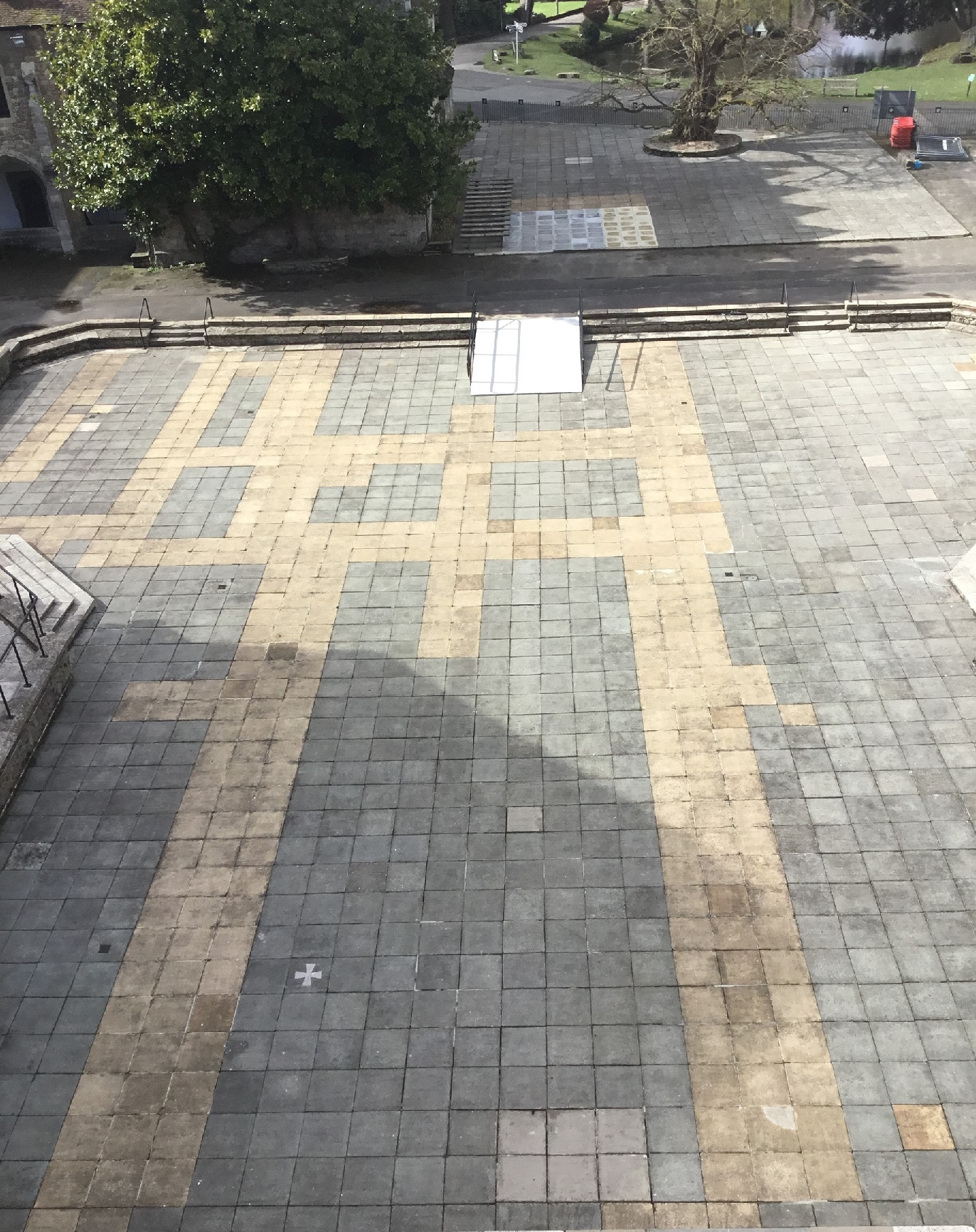
The foundations of the original mediaeval church can be seen outlined by the yellow paving stones. There was choir where the friars prayed and a nave where the pilgrims’ worshiped. The two were divided by a meeting space where friars would meet the pilgrims’ and visitors.
Photo caption (1st) Painting of the Mediaeval Church that stood on the grounds
Photo caption (2nd) The yellow paving stones showing the outline of the original church

The 15th Century
A tradition developed that St Simon Stock (died 1265), Prior General of the Order, had a vision of Our Lady promising her protection to those who wore the Carmelite habit, and the wearing of the scapular subsequently became an important Marian devotion. In 1417 the church was consecrated.
Photo caption The Scapular Vision statue in the Relic Chapel (Flemish 16th Century)

The 16th Century
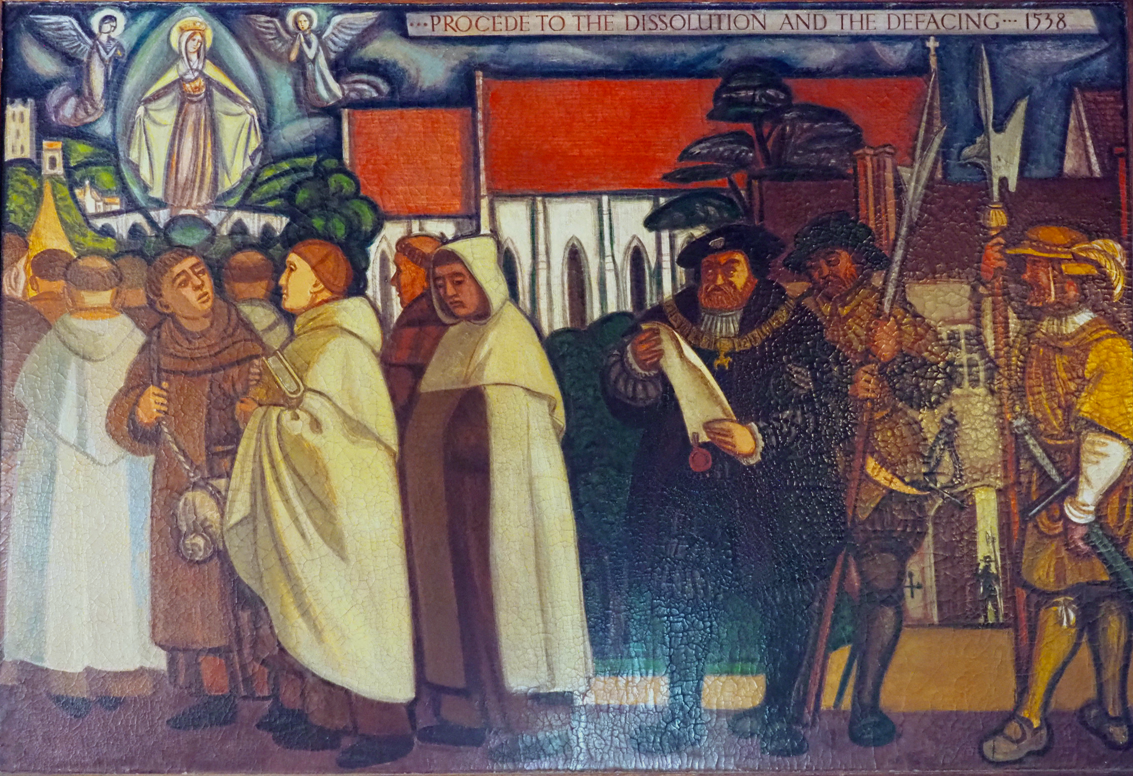
In 1538 during the Dissolution of the Monasteries, The Friars passed into the hands of Sir Thomas Wyatt of Allington Castle. The Wyatts lost their lands under Queen Mary and later, in the reign of Queen Elizabeth I, Sir John Sedley took over the property. He made considerable alterations to the buildings in the 1590s.
Photo captionThe Carmelites leave Aylesford at the Dissolution of the Monesteries in 1538 by Adam Kossowski
The 17th Century

Photo caption The Friars as a country home in the 17th century by the courtesy of the Earl of Aylesford
In 1633 Sir Peter Rycaut, a Dutch international financier, bought The Friars from the Sedley family. The Rycauts took the Royalist side at the outbreak of the Civil War in 1642; during the war The Friars was sequestrated by Parliamentary forces and served for a time as the meeting place of the Parliamentary Committee for Kent. Sir Peter died penniless in 1653 and his wife and youngest son, Sir Paul Rycaut, struggled to pay off the family's debts. Sir Paul was a renowned writer and traveller and was born at the priory in 1628 and educated at Trinity College, Cambridge, graduating in 1650.Sir Paul Rycaut spent the next ten years travelling extensively in Asia, Africa and Europe and wrote numerous historical books, including works on the state of the Ottoman Empire. Sir Paul was elected a Fellow of the Royal Society on 12 December 1666, knighted at Whitehall in 1685 and died in November 1700.
However, Sir Paul and his mother Dame Mary's struggle with finances were to no avail and Dame Mary was forced to sell The Friars in 1657 to Sir John Banks, a businessman who sold supplies to the British Navy. In the 1670s he turned The Friars into fine Caroline mansion where his visitors included the diarist Samuel Pepys. Elizabeth Banks inherited The Friars from her father and her husband, Heneage Finch, became the 1st Earl of Aylesford. He lived at The Friars but the family then moved to Packington Hall, Warwickshire. They did not live at The Friars again, although it was, at times, used as the dower house and was frequently rented out to other families.

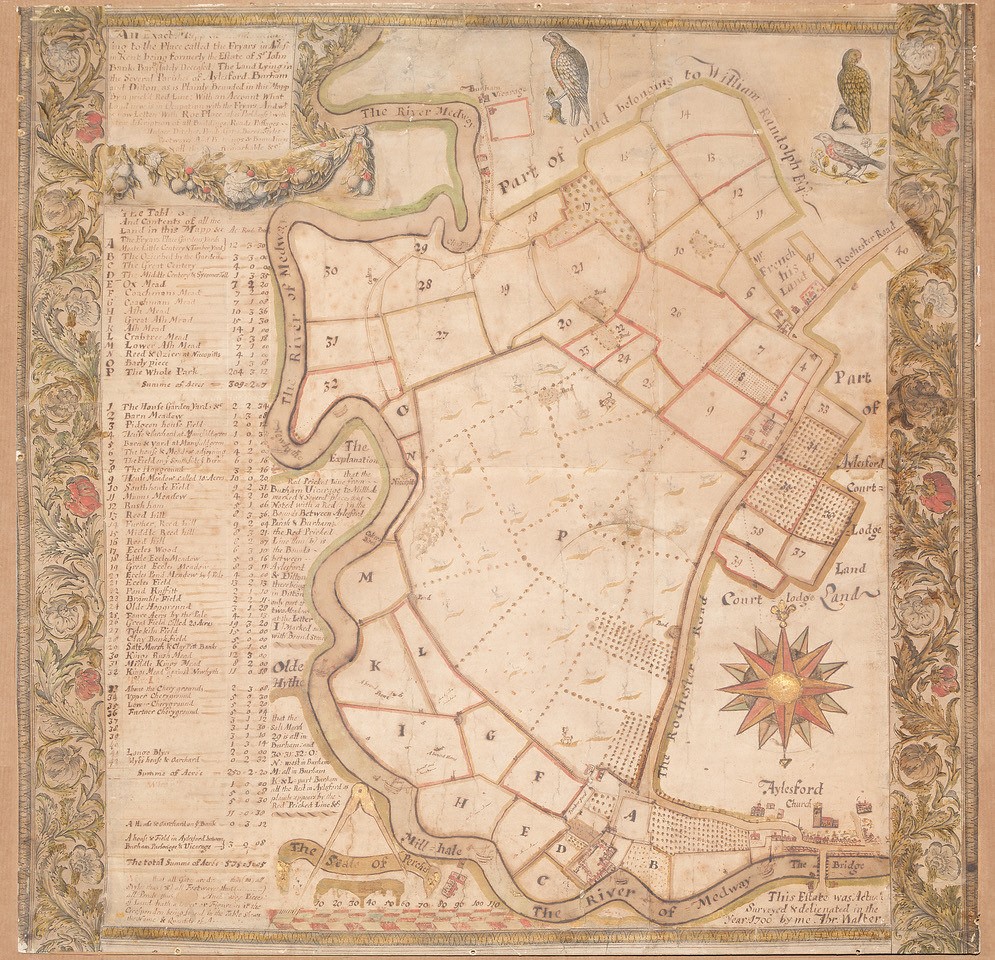
Photo caption Portrait of Sir John Bank attributed to Sir Peter Lely, at Packington Hall, courtesy of the Earl of Aylesford.
Photo captionA Seventeenth Century map of the estate of Sir John Banks of Aylesford.
20th Century
In the twentieth century Mrs Woolsey and her son-in-law Mr Copley Hewitt, lavished care on the house. At this time The Friars became an important centre for scouting activities and Lord Baden-Powell visited on one occasion. A fire in 1930 caused immense damage but the restoration work brought to light many original features. See here for an extract from our Spring 2023 Newsletter with history of the Hewitt family.
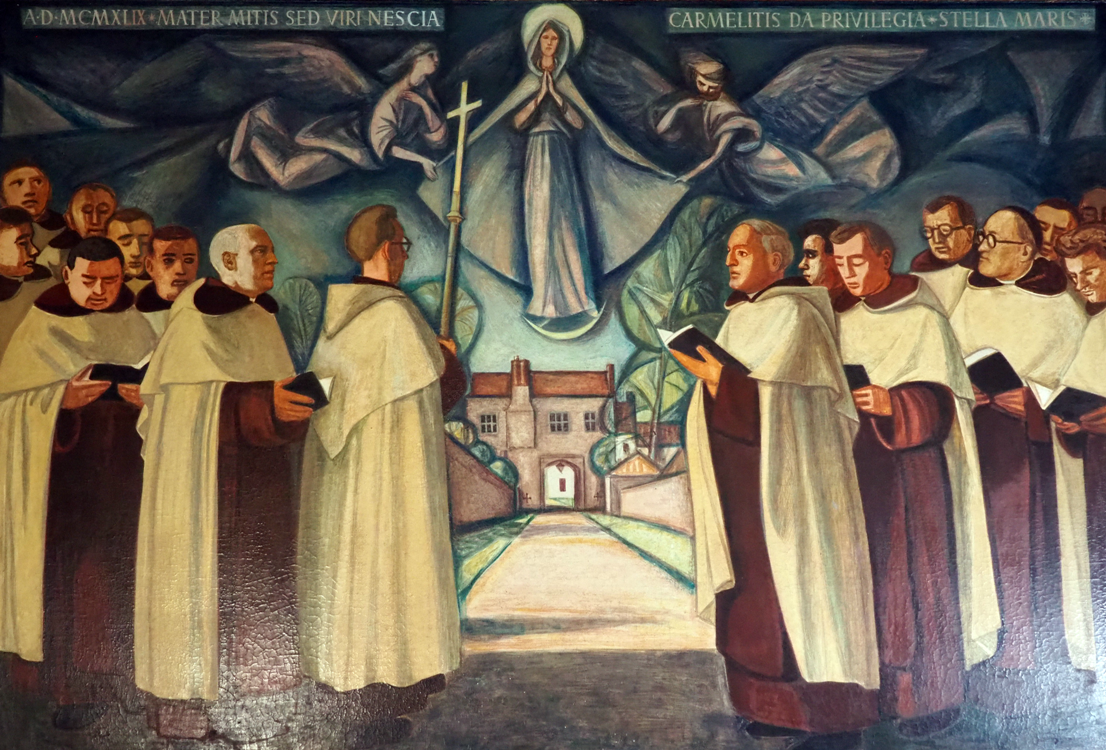
In 1949 The Friars was put up for sale, so the Carmelites were able to buy back their motherhouse. Fr Malachy Lynch, the first Prior began the task of restoring the buildings and within a short time The Friars became a flourishing pilgrimage centre.
In partnership with Adrian Gilbert Scott, Fr Malachy conceived the idea of the open-air shrine and he gathered craftsmen and artists to help him. Work began on building the Shrine in 1958.
Outstanding among the artists were Adam Kossowski, who made the ceramics, and Philip Lindsey Clark and his son Michael Clark, both sculptors. Fr Malachy described The Friars as "a prayer in stone".
In the presence of Cardinal Heenan, Archbishop Cyril Cowderoy rededicated the Shrine in 1965 and it now serves as a centre of prayer for all Christians in Kent and a place of peace for those who search for meaning in their lives.
Photo caption (above left)The aftermath of The Fire in 1930
Photo caption (below left) The return of the Carmelites to Aylesford in 1949 by Adam Kossowski

21st Century (The Friars today)
In the last two decades the work of rebuilding has continued but another vital thing has happened. The friars has become more and more part of the life of the County of Kent – both religious and social. Besides religious activities, countless organisations enjoy using the facilities at The Friars for meetings and celebrations. The beauty of the place and the wonderful works of art have also attracted the media, and over the last few years the BBC and ITV have broadcast a number of wonderfully made programmes from The Friars .
For Carmelites, prayer and work make a seamless whole so, while personal and public prayer is at the core of their lives, they are also busy serving the community.
Each member of the Community has his area of work at the priory, be it in administration, maintenance or giving retreats and counselling. Some of the friars work outside in the community at large in prison work, school and hospital chaplaincy and local radio to name a few areas of activity. This is the main difference between friars and monks. Friars have a community life, and the fraternity gives them the support that enables them to go out and work among people, spreading gospel values in whatever way is appropriate to the time and place.


CaptionComparison of the original friars and the friars today at study.